

Third Party Pharma Manufacturing – Casca Remedies
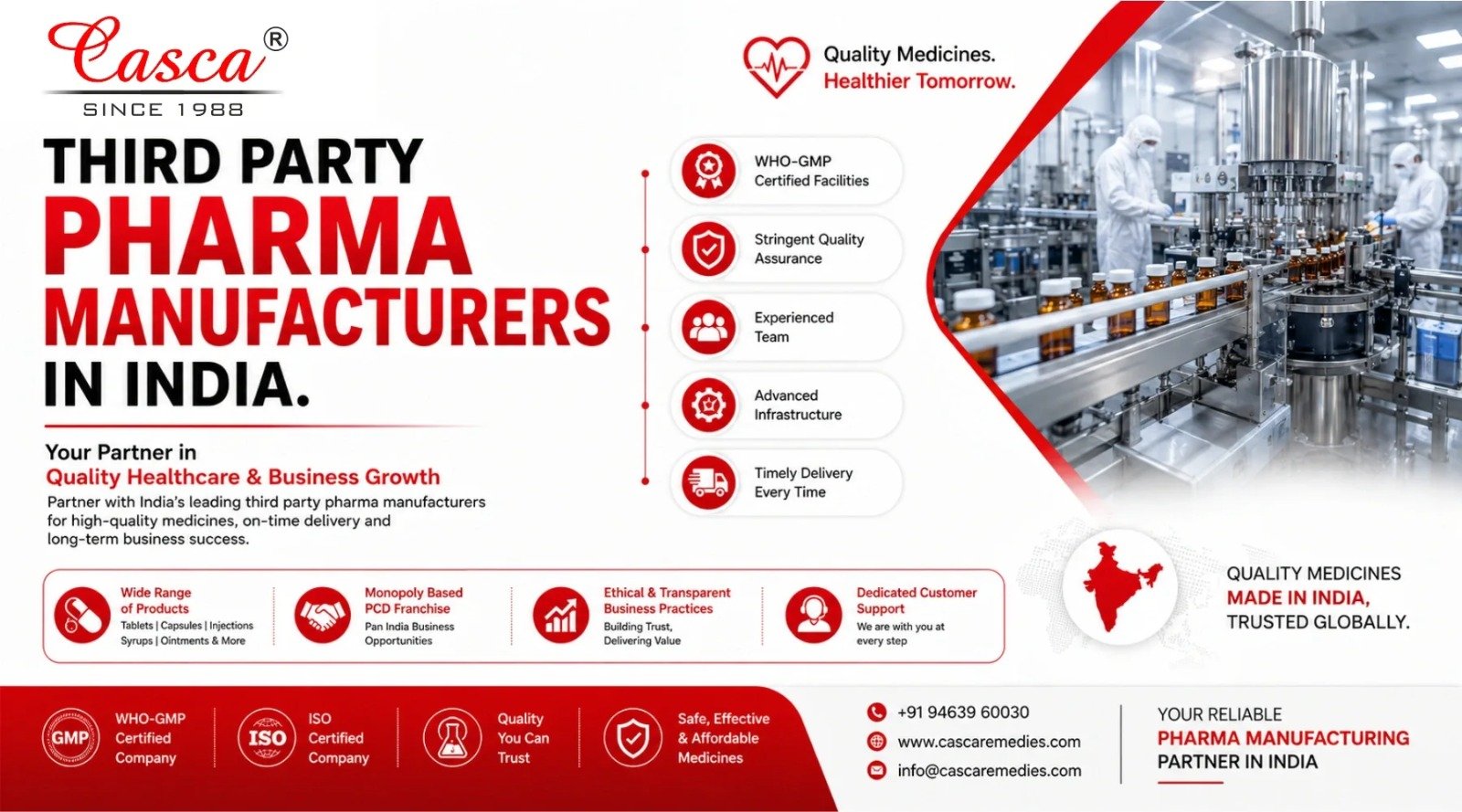
Third party pharma manufacturing refers to an arrangement in which a pharmaceutical company (the marketing/brand company) outsources the production of its medicines to another pharmaceutical company that owns a WHO-GMP certified manufacturing facility. Under this model, the brand company provides the product formulation, packaging design, and specifications, while the manufacturing unit handles sourcing of raw materials, production, quality testing, and packing of the finished pharmaceutical products.
This model allows companies — especially small and mid-sized pharma marketing firms, PCD (Propaganda Cum Distribution) franchise businesses, and startups — to launch and sell medicines under their own brand name without investing in their own manufacturing infrastructure, machinery, or regulatory licenses. The manufacturer, in turn, utilizes its production capacity efficiently by manufacturing for multiple brand partners.
Third party pharma manufacturing is widely used for tablets, capsules, syrups, injectables, ointments, dry syrups, and other dosage forms, and typically follows strict quality standards including GMP, WHO-GMP, ISO certification, and drug regulatory approvals to ensure the safety, efficacy, and consistency of the final product.
Key benefits include:
- Low investment and reduced financial risk
- Faster market entry and product launch
- Access to advanced manufacturing technology and expertise
- Flexibility to focus on marketing, sales, and distribution
- Wide range of formulations and customizable packaging
FAQs
What is third party manufacturing?
It's an arrangement where a company (the brand owner) outsources production of its goods to another company (the manufacturer) that already has the facility, equipment, licenses, and workforce. The brand owner supplies the formula/design and specifications, and sells the finished product under its own name.
How is it different from private label manufacturing?
In third party manufacturing, the manufacturer often provides the formulation/recipe and expertise, and the brand just markets it. In private label, the brand typically brings its own formula/design and the manufacturer just produces it. In practice the terms are often used interchangeably, and many manufacturers offer both models.
Who typically uses this model?
Common in pharmaceuticals, cosmetics/personal care, food and beverages, nutraceuticals/supplements, and electronics. Small and mid-size brands use it to enter a market without capital investment in plants and machinery.
What licenses/certifications does a manufacturer need?
Depends on the industry, but commonly includes:
GMP (Good Manufacturing Practice) certification
ISO certifications (9001, 22000, etc.)
Drug license (for pharma, in India this means state FDA license)
FSSAI license (for food, in India)
WHO-GMP for export-oriented pharma units
What should a brand check before partnering with a manufacturer?
Valid licenses and certifications
Production capacity and minimum order quantity (MOQ)
Quality control processes and testing labs
Track record/client references
Raw material sourcing and supply chain reliability
Turnaround time
Packaging capabilities
Pricing structure and payment terms
What's the typical process?
Finalize formulation/product spec
Sign agreement (including confidentiality/NDA)
Manufacturer sources raw materials
Production and quality testing
Packaging and labeling (often brand-owned)
Dispatch/logistics to the brand
Who owns the formula/IP?
This varies by contract. Some agreements let the brand retain full ownership and confidentiality; others (especially where the manufacturer provides the formula) may restrict exclusivity or reuse. This should always be spelled out clearly in the agreement.
8R9Q+62W, 11K, Kuldeep Nagar, Nanak Pura, Nanhera, Ambala Cantt, Haryana 133004
Get Directions- 09463960030
-
 Whatsapp
 - https://cascaremedies.com/third-party-manufacturing/
 Own or work here? Claim Now! Claim Now!
Contact with business owner
 Your request has been submitted successfully.